

Explore cordless power tools, kits, batteries, chargers, accessories and related equipment available to Canadian shoppers. Compare product options and follow useful buying guides before you buy.




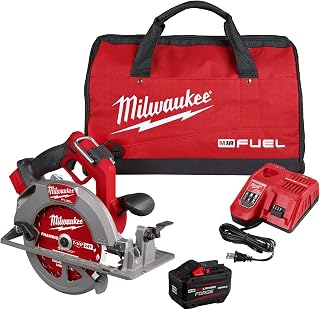

Choosing a Milwaukee cordless circular saw is not simply a matter of selecting the model with the highest advertised power. The right saw depends on cutting depth, blade diameter, motor technology, battery platform, handling, visibility, shoe construction, intended material and the type of work you perform most often.
Milwaukee's M18 system gives Canadian buyers a broad selection of cordless saws for construction, renovation, framing, woodworking, exterior projects and general job-site work. Some models prioritise compact handling, while others are designed around maximum cutting performance or rear-handle control.
This guide focuses on the factors that matter when comparing the best Milwaukee cordless circular saws in Canada in 2026. Model specifications should always be checked against the current Canadian listing before purchase because configurations, included batteries, chargers and regional availability can change.
The following Milwaukee circular saw models and configurations represent the main types worth comparing when shopping in Canada. They should not be treated as identical tools because blade size, motor configuration, ergonomics and intended applications can differ substantially.
The M18 FUEL 7-1/4-inch circular saw is a strong choice for users who want a full-size cordless saw for demanding construction and woodworking applications. Its larger blade provides substantial cutting capacity, while the FUEL platform is designed around Milwaukee's brushless motor technology and electronic control system.
A 7-1/4-inch format is particularly useful for dimensional lumber, sheet goods and common construction materials. Buyers should pay attention to the exact model number because tool-only and kit versions can have different included accessories.
A rear-handle circular saw is designed for users who prefer a different balance and grip arrangement from a conventional side-handle design. The rear handle can provide a more familiar cutting position for certain framing and construction tasks.
This type of saw is especially relevant to professionals who make repeated long cuts or work extensively with dimensional lumber. The rear-handle configuration can also influence how the tool feels during plunge cuts and longer straight cuts, so physical ergonomics should be considered alongside specifications.
A 6-1/2-inch Milwaukee M18 circular saw can be a practical middle ground for users who want cordless convenience without moving to the largest saw format. The smaller blade can make the tool feel easier to manoeuvre, especially when cutting sheet material or performing general renovation work.
For many homeowners, remodelers and tradespeople, a 6-1/2-inch saw can provide enough capacity for common tasks while remaining relatively manageable. Check the exact specification for maximum cutting depth at 90 and 45 degrees before purchasing.
The M18 FUEL 6-1/2-inch category is worth considering when you want brushless performance in a more compact format. This configuration can make sense for users who regularly move between different cutting locations and do not always need the maximum capacity of a 7-1/4-inch blade.
The key advantage of comparing a 6-1/2-inch FUEL model against a larger saw is not simply size. It is the balance between cutting capacity, portability, battery requirements and handling. Buyers should match the saw to their most frequent material thickness rather than automatically choosing the largest model.
Compact Milwaukee circular saw configurations can be useful when portability and control matter more than maximum cutting capacity. These saws may appeal to DIY users, installers, remodelers and tradespeople who work in confined spaces.
Compact does not automatically mean less useful. For tasks involving trim stock, plywood, smaller lumber and repeated short cuts, a lighter and easier-to-position tool can sometimes be more practical than a larger framing-oriented saw.
Tool-only versions deserve separate consideration because they can reduce unnecessary duplication for buyers who already own compatible Milwaukee batteries and chargers. The saw itself may be the same basic tool offered in a kit, but the package contents are different.
Before choosing a tool-only configuration, confirm that you already have a compatible M18 battery with sufficient capacity for your intended workload. If you are starting from zero, a kit may be more practical because it can include a battery and charger.
A Milwaukee circular saw kit can be a better starting point for new M18 users. Kits can vary significantly, so compare the included battery type, charger, blade and other accessories rather than comparing the headline price alone.
Battery capacity matters particularly with circular saws because cutting dense or thick material can place greater demands on the power system. A higher-capacity battery may add weight, so there is a trade-off between runtime and tool balance.
High-performance FUEL configurations are aimed at buyers who want cordless cutting capability that can handle demanding job-site applications. The important distinction is that high performance should be evaluated in relation to the work rather than treated as a universal requirement.
For occasional DIY work, a premium high-output configuration may provide capabilities you rarely use. For framing, repeated construction cuts or professional workloads, the additional performance and electronic control features may be more relevant.
Construction-focused 7-1/4-inch saws are appropriate for users who routinely cut dimensional lumber, plywood and other common building materials. The larger blade format is particularly useful when cutting thicker stock or making bevel cuts that reduce effective cutting depth.
When comparing these models, examine the shoe, bevel range, depth adjustment, blade visibility, weight distribution and handle design. Two saws with similar blade diameters can feel very different during extended use.
General renovation work often calls for a versatile saw rather than the most powerful available option. A balanced M18 circular saw can be useful for cutting framing lumber, plywood, shelving material, boards and other common materials.
If your work involves frequent overhead cuts, tight spaces or moving between rooms, ergonomics may be more important than maximum output. Consider the complete tool rather than judging it solely from motor specifications.
The first buying decision should be based on your typical material. Cutting 2x4 lumber is different from cutting thick hardwood, plywood, OSB or composite sheet material. A saw that works well for one application may not be the most convenient choice for another.
For general construction, 6-1/2-inch and 7-1/4-inch saws cover many common applications. If you frequently cut thicker material, the larger format generally provides more useful capacity.
Blade diameter directly affects cutting capacity. A 7-1/4-inch blade generally offers greater depth than a 6-1/2-inch blade, although the exact cutting depth depends on the saw's design and adjustment position.
Do not assume that a larger blade automatically produces better results. Larger saws can also be heavier and may feel less convenient during detailed or confined work.
Maximum cutting depth is normally greatest when the blade is positioned at 90 degrees. Tilting the shoe for a bevel cut reduces the effective depth available.
This distinction is important when buying a saw for framing, roofing, cabinetry or other work where bevel cuts are common. Compare both 90-degree and 45-degree specifications instead of looking at only one number.
Milwaukee's FUEL circular saws use brushless motor technology. Brushless systems can offer advantages in efficiency, electronic control and durability compared with traditional brushed designs, although the exact performance depends on the complete tool and battery combination.
For occasional users, a brushless model may not always be necessary. For frequent professional use, however, motor technology becomes a more important part of the buying decision.
The battery is an important part of cordless saw performance. A circular saw should not be evaluated independently from its battery because the battery affects runtime, weight and overall handling.
Compact M18 batteries can keep the tool lighter and may be convenient for short cutting sessions. They can be attractive when portability matters more than maximum runtime.
Higher-capacity batteries are worth considering for extended cutting sessions. They can reduce the need for frequent battery changes, but their additional weight can alter the balance of the saw.
When a compatible saw is designed to take advantage of higher-output M18 batteries, pairing the tool with an appropriate high-output battery can be useful for demanding work. Always check the manufacturer's current compatibility information for the specific saw and battery combination.
The choice between a tool-only package and a kit depends largely on your existing battery collection.
An electric brake can stop the blade quickly after the trigger is released. This feature can improve convenience between cuts and is useful on a busy job site.
Bevel capability determines how easily the saw can make angled cuts. Look for a stable adjustment mechanism and clear markings that are easy to read while working.
A reliable depth adjustment lets you match the blade exposure to the material. Proper adjustment can improve control and help avoid unnecessarily deep blade exposure.
Blade visibility is important for accurate cuts. A well-designed shoe and sight line can make it easier to follow a marked cutting line without constantly repositioning the tool.
The shoe supports the saw against the workpiece. A rigid metal shoe can provide a stable platform and may be preferable for demanding job-site use. Check the shoe design, adjustment mechanism and overall rigidity when comparing models.
Weight becomes increasingly important during repeated cuts. A saw that feels comfortable for five minutes may feel very different after a full day of work.
Do not compare weight without considering the battery. A tool-only weight can be substantially different from the working weight once a battery and blade are installed.
Milwaukee is one of several major professional power-tool brands competing in the cordless circular saw market. When comparing Milwaukee with DeWalt, Makita, Bosch or other manufacturers, battery-platform compatibility should be one of the first considerations.
Both brands offer established cordless ecosystems and multiple circular saw configurations. The best choice often depends on which battery platform you already use, the saw format you prefer and the specifications of the models being compared.
Makita offers a broad cordless tool ecosystem and several circular saw designs. Buyers should compare ergonomics, blade size, battery system, cutting capacity and available accessories rather than selecting a brand based only on reputation.
Bosch is another established power-tool manufacturer with circular saw options. Compare the actual specifications and intended application of each model. Brand loyalty is less important than choosing a saw that fits your workload.
A larger saw provides greater cutting capacity, but it can also add weight and bulk. If most of your work involves thinner material, a smaller model may be easier to handle.
Buying an expensive saw and pairing it with an unsuitable battery can undermine the cordless experience. Consider battery capacity, output, weight and compatibility together.
A tool-only model and a complete kit should not be compared as if they contain the same products. Always identify exactly what comes inside the box.
Brushless technology is valuable, but it is only one part of the tool. Shoe quality, ergonomics, cutting depth, bevel adjustment, visibility and battery compatibility can have a greater practical effect on your daily experience.
A circular saw is only as useful as the blade installed in it. Consider the types of blades available for the materials you intend to cut and choose the appropriate tooth configuration for each application.
Blade selection should match the material and desired finish. A framing blade is designed for fast construction cuts, while a finer-tooth blade is generally more suitable when cleaner cuts are required in suitable sheet goods or wood products.
Always verify the blade diameter, arbor specification, maximum rated speed and material compatibility before installation.
A cordless circular saw remains a high-speed cutting tool and should be treated with the same level of caution as a corded saw. Battery power removes the electrical cord but does not remove cutting hazards.
Canadian conditions can create additional considerations for cordless tools. Battery performance can be affected by extreme cold, so outdoor users should follow the battery manufacturer's storage, charging and operating guidance.
Keep batteries protected from unnecessary exposure to extreme temperatures and avoid charging a battery outside the manufacturer's recommended temperature range. For winter construction work, practical battery management can be just as important as selecting the saw itself.
Regular maintenance helps keep a circular saw ready for work. After cutting, remove accumulated dust and debris from the tool according to the manufacturer's cleaning instructions.
Professional buyers should consider productivity as well as specifications. A saw that saves time on repeated cuts can be more valuable than one with a slightly higher specification that is uncomfortable to operate.
Consider how often the saw will be used, how many cuts are made per day, what materials are involved, how frequently batteries must be changed and whether the tool needs to be carried between different floors or job sites.
Framers may prioritise cutting speed, capacity and balance. Renovation contractors may value versatility and portability. Finish-oriented users may place greater emphasis on control and blade selection. These different priorities explain why there is no single Milwaukee circular saw that is perfect for every buyer.
Customer ratings can be useful, but they should not be treated as a substitute for technical specifications. Look for recurring comments about balance, blade visibility, battery life, cutting performance and durability rather than relying on a single positive or negative review.
When comparing customer feedback, also check whether reviews relate to the exact model number. Milwaukee often sells similar-looking tools in different configurations, and confusing model variants can lead to inaccurate comparisons.
Before purchasing, verify the exact model number, blade diameter, maximum cutting depth, bevel range, battery compatibility, included accessories and package contents. Canadian listings can differ from listings in the United States, so do not assume that an American product page represents the Canadian configuration.
Also check whether the listing is for a tool-only product or a complete kit. Compare the final package rather than the headline product name.
The best Milwaukee cordless circular saw is ultimately the model that matches your material, cutting depth, working environment, battery collection and frequency of use. A professional framing contractor may have very different requirements from a homeowner completing occasional renovation projects.
For demanding construction work, the M18 FUEL 7-1/4-inch category deserves close attention because it combines a full-size blade format with Milwaukee's higher-performance cordless platform. For buyers who prioritise easier handling, a 6-1/2-inch configuration can be a more practical alternative.
Existing M18 users should pay particular attention to tool-only options and battery compatibility. New users should compare complete kits and calculate the cost of building the battery platform. In every case, compare the exact model number, cutting specifications, ergonomics, package contents and current Canadian availability before making a decision.
A Milwaukee M18 FUEL 7-1/4-inch circular saw or compatible rear-handle configuration is generally the type to consider for demanding framing work because the larger blade format provides substantial cutting capacity. The best choice still depends on the user's preferred handling and exact workload.
For many DIY applications, a 6-1/2-inch circular saw can provide useful capacity while remaining relatively manageable. Check the exact cutting depth against the thickness of the material you expect to cut.
FUEL models are designed for users who want Milwaukee's brushless motor technology and higher-performance cordless tool platform. Whether the additional capability is worthwhile depends on how frequently you use the saw and how demanding your applications are.
Battery compatibility should be checked against the exact saw model and current Milwaukee specifications. Although M18 tools share the M18 platform, battery type and output can influence performance, runtime and handling.
A tool-only model can make sense when you already own compatible M18 batteries and a charger. If you do not own the platform, compare the cost of a complete kit against purchasing the battery and charger separately.
Not necessarily. A 7-1/4-inch model normally provides greater cutting capacity, while a 6-1/2-inch saw can be easier to handle. Choose according to the material thickness, cutting style and portability you actually need.
The appropriate battery depends on the saw model and workload. Higher-capacity or high-output batteries can be useful for demanding applications, while smaller batteries can reduce overall weight. Follow Milwaukee's current compatibility recommendations.
They can be used in Canadian conditions when operated and stored according to the manufacturer's instructions. Battery temperature is particularly important in cold weather, so follow the recommended temperature limits for charging and operation.
There is no universal replacement interval. Blade life depends on material, cutting frequency, blade quality and operating conditions. Replace or sharpen a blade when it becomes unsuitable for the intended application, damaged or excessively worn.
Confirm the exact model number, blade size, cutting depth, bevel capability, battery compatibility, weight, included accessories and current Canadian availability. Comparing these factors provides a more reliable purchasing decision than looking at price or ratings alone.
When comparing the best Milwaukee cordless circular saws in Canada, focus on application first and specifications second. The right combination of blade diameter, motor platform, battery, cutting capacity and ergonomics can make a significant difference to everyday usability.
Compare the exact model rather than relying solely on a product family name. Check current Canadian specifications, read reviews for the precise configuration, verify package contents and consider the total cost of ownership. This approach makes it easier to select a Milwaukee M18 circular saw that fits your projects without paying for capabilities you do not need.