

Explore cordless power tools, kits, batteries, chargers, accessories and related equipment available to Canadian shoppers. Compare product options and follow useful buying guides before you buy.


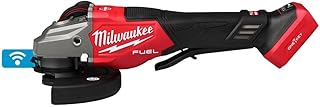

Choosing a Milwaukee cordless angle grinder is less about finding the most powerful model and more about matching the grinder to the work you actually perform. Grinding welds, cutting steel, removing rust, preparing concrete, sharpening tools, and working in confined areas can all favour different grinder designs.
For Canadian buyers, the M18 platform is particularly important because battery compatibility can affect the total cost of ownership. Milwaukee offers a broad range of M18 grinders, from compact 4-1/2-inch and 5-inch models to larger 6-inch and 7-inch/9-inch machines. The current range also includes conventional fixed-speed grinders, braking models, variable-speed versions, flathead designs, and models with ONE-KEY connectivity.
The models below should therefore be compared by application rather than simply by ranking. A compact 5-inch grinder may be the better choice for general fabrication, while a 6-inch model can make more sense when larger accessories and heavier material removal are required.
The 2980-20 is one of the most versatile choices in the current M18 grinder range. It accepts accessories from 4-1/2 inches through 6 inches, giving users more flexibility than a grinder restricted to smaller wheels. Milwaukee rates the POWERSTATE brushless motor at 9,000 RPM and describes the machine as delivering the power equivalent of a 13-amp corded grinder.
Its RAPIDSTOP braking system stops accessories in under three seconds, while REDLINK PLUS electronic protection helps manage overload, overheating, and over-discharge conditions. The design also uses a metal housing and gearing system and supports tool-free accessory changes through the FIXTEC system.
Why compare it: The 6-inch capacity provides useful flexibility without moving into the much larger 7-inch/9-inch grinder category.
The 2981-20 is the slide-switch, lock-on version of Milwaukee's 4-1/2-inch to 6-inch braking grinder family. It shares the 9,000 RPM brushless motor, 13-amp corded-power positioning, RAPIDSTOP braking, FIXTEC accessory changes, and compatibility with M18 batteries.
The main reason to consider this version instead of a paddle-switch grinder is the control layout. A slide switch with lock-on can be preferable for users who spend extended periods performing repetitive grinding where continuous operation is appropriate. However, switch preference is highly personal, so buyers should consider how they normally position and control a grinder.
Why compare it: It combines broad accessory compatibility with a conventional slide-switch control style.
The 3672-20 is aimed at applications where variable speed is more useful than simply having maximum RPM available all the time. Milwaukee's current M18 FUEL 4-1/2-inch to 6-inch variable-speed grinder family provides multiple speed settings and is designed for greater control across different grinding and cutting tasks. The corresponding kit is listed with an M18 FUEL variable-speed braking grinder and two REDLITHIUM FORGE XC8.0 batteries.
Variable speed can be valuable when the accessory or workpiece benefits from a more controlled operating speed. It can also make the grinder more adaptable when switching between aggressive material removal and tasks that require greater surface control.
Why compare it: Choose this type of grinder when speed control is more important to you than having a simple single-speed setup.
The 2883-20 combines an 8,500 RPM POWERSTATE brushless motor with RAPIDSTOP braking, electronic clutch protection, overload protection, tool-free guard adjustment, FIXTEC accessory changes, and ONE-KEY tracking and tool management. Milwaukee describes it as generating 11-amp corded power.
This model uses a slide switch with lock-on. That makes it particularly relevant for buyers who prefer the feel and operating method of a traditional slide-switch grinder while still wanting modern electronic protection and braking features.
Why compare it: It is a strong option for users who value tool management and a lock-on slide-switch design.
The 2882-20 is closely related to the 2883-20 but uses a paddle switch without a lock-on function. It provides an 8,500 RPM POWERSTATE brushless motor, RAPIDSTOP braking, electronic clutch protection, overload protection, tool-free guard adjustment, FIXTEC accessory changes, and ONE-KEY tracking.
The paddle-switch arrangement can be useful for buyers who prefer a grinder that can be controlled from different hand positions. Because it is a no-lock design, the switch must remain actuated during operation.
Why compare it: It is worth considering when paddle-switch ergonomics and ONE-KEY functionality are priorities.
The 2880-20 provides the core second-generation M18 FUEL grinder design without ONE-KEY connectivity. It uses a paddle switch with no lock-on, an 8,500 RPM brushless motor, RAPIDSTOP braking, electronic clutch protection, overload protection, FIXTEC accessory changes, and tool-free guard adjustment.
For buyers who do not need connected tool tracking, this configuration can make more sense than paying attention to features they will not use. The fundamental grinder characteristics remain focused on cutting and grinding performance, protection, and accessory-change convenience.
The 2881-20 is the slide-switch, lock-on version of the second-generation 4-1/2-inch/5-inch M18 FUEL braking grinder. Milwaukee specifies an 8,500 RPM POWERSTATE brushless motor, RAPIDSTOP braking, an electronic clutch, overload protection, FIXTEC accessory changes, and a 5/8-inch-11 spindle.
The major distinction is the control system. Buyers who already prefer slide-switch grinders may find this configuration more familiar. The lock-on function is also relevant to prolonged applications where continuous operation is suitable.
The 2888-20 is a smaller variable-speed alternative for users who want speed adjustment while remaining in the common 4-1/2-inch and 5-inch accessory class. Milwaukee lists five speed settings and a POWERSTATE brushless motor capable of 3,500 to 8,500 RPM. It also includes RAPIDSTOP braking and a paddle-switch, no-lock configuration.
This configuration is particularly interesting for buyers who regularly change between different materials or accessories and want more control than a conventional fixed-speed grinder provides.
The 2886-20 is designed around accessibility rather than simply increasing grinder size. Its flathead construction gives the grinder a lower profile, allowing it to reach areas where the head of a conventional 5-inch grinder may be difficult to position. Milwaukee lists an 8,500 RPM brushless motor, 11-amp corded-power positioning, RAPIDSTOP braking, a paddle switch, and tool-free guard adjustment.
A flathead grinder should not automatically be considered better than a conventional grinder. Its advantage is situational. If your work frequently involves tight clearances, restricted access, fabrication joints, or awkward angles, the lower-profile head can be more important than additional features.
The 2785-20 belongs in a separate size class from the compact 4-1/2-inch and 5-inch grinders. It is designed for 7-inch to 9-inch accessories and provides a substantially larger grinding capacity. Milwaukee specifies 6,600 RPM and positions the tool as delivering the power of a 15-amp corded large angle grinder.
This is not the right choice for every buyer. Larger accessories increase the scale of work the grinder can handle, but the machine is also intended for heavier applications. For ordinary workshop grinding and smaller fabrication tasks, a 4-1/2-inch or 5-inch grinder is generally a more appropriate form factor.
When comparing Milwaukee cordless angle grinders, the FUEL designation deserves attention. Milwaukee's M18 FUEL grinder platform combines a POWERSTATE brushless motor, REDLITHIUM battery technology, and REDLINK PLUS electronic intelligence. The manufacturer describes these components as the foundation of its M18 FUEL cordless grinder system.
For buyers, the important point is not simply the branding. Look at the actual grinder specification, switch arrangement, accessory size, braking system, electronic protection, speed control, and battery requirements.
A basic grinder can be sufficient for occasional light work. A FUEL model becomes more attractive when the grinder will be used frequently, subjected to demanding workloads, or integrated into a broader M18 tool collection.
Four-and-a-half-inch grinders are compact and versatile. They are commonly suited to cutting metal, grinding welds, removing surface material, deburring, and general fabrication. Their smaller size can also make them easier to control in confined workspaces.
A 5-inch grinder provides a useful middle ground between compactness and working capacity. Several Milwaukee M18 models support both 4-1/2-inch and 5-inch accessories, so buyers can choose the accessory size according to the application rather than being restricted to one diameter.
A 6-inch-capable grinder such as the 2980-20 or 2981-20 is more versatile when larger accessories are useful. Milwaukee specifically designs these grinders for 4-1/2-inch through 6-inch applications.
The 2785-20 is intended for substantially larger applications. Its 7-inch/9-inch capacity and 6,600 RPM specification put it into the large angle grinder category rather than the compact workshop grinder category.
Brushless motor technology is especially relevant in cordless tools because the motor, electronics, and battery have to work together efficiently. Milwaukee's M18 FUEL range uses POWERSTATE brushless motors and REDLINK PLUS electronic intelligence to coordinate tool and battery performance.
For the buyer, this means the motor should be evaluated as part of the complete system rather than as an isolated RPM figure. A higher no-load RPM does not automatically mean a grinder will remove material faster in every real-world application. Accessory selection, battery output, workload, material, pressure, and electronic control all influence performance.
RPM describes rotational speed, but it should not be used as the only performance measurement. For example, the current 4-1/2-inch/5-inch M18 FUEL braking grinders commonly operate at up to 8,500 RPM, while the 4-1/2-inch-to-6-inch 2980 family reaches 9,000 RPM and the large 2785-20 operates at 6,600 RPM.
The difference reflects the intended accessory size and application. Larger wheels generally operate at lower rotational speeds than smaller wheels. Always match the accessory's maximum rated speed to the grinder and follow the accessory manufacturer's instructions.
Battery choice can materially affect how practical a cordless grinder feels. Milwaukee states that its M18 grinders are compatible across the M18 battery system, while its product descriptions specifically highlight REDLITHIUM HIGH OUTPUT packs for demanding grinder applications.
For occasional work, a smaller compatible M18 battery can reduce overall weight. For sustained grinding and cutting, a higher-capacity or high-output pack can be a more sensible choice if the additional weight is acceptable.
Remember that tool-only packages do not necessarily include a battery or charger. For example, Milwaukee lists the 2880-20, 2881-20, 2882-20, 2883-20, 2886-20, and 2888-20 as grinder configurations where the battery may not be included.
A tool-only grinder is usually the logical choice when you already own compatible M18 batteries and a suitable charger. Buying another battery and charger unnecessarily can increase the total purchase cost and add equipment you may not need.
A kit can make more sense when entering the M18 platform. Some current Milwaukee grinder kits include batteries and a charger. The 2980-22, for example, includes two M18 REDLITHIUM HIGH OUTPUT XC6.0 battery packs and an M18/M12 Rapid Charger.
Do not compare the price of a bare tool directly with the price of a complete kit without accounting for what is included. A lower advertised price can represent a tool-only package, while a higher price may include batteries and charging equipment.
A paddle switch can be attractive to users who prefer operating the grinder while maintaining a hand position around the body of the tool. Milwaukee's 2880-20 and 2882-20 use paddle-switch, no-lock configurations.
A slide switch with lock-on provides a different operating experience. The 2881-20 and 2883-20 use this configuration.
Neither control arrangement is universally better. Choose based on the way you work, the positions you normally grind in, and your comfort with the switch design.
Modern Milwaukee M18 FUEL braking grinders use RAPIDSTOP technology to reduce accessory coast-down time. Milwaukee specifies stopping most wheels in less than two seconds for several 4-1/2-inch/5-inch braking models, while the 4-1/2-inch-to-6-inch 2980 family is specified to stop accessories in under three seconds.
A brake does not make an angle grinder risk-free. It simply addresses one aspect of tool behaviour after the switch is released. Correct guards, suitable accessories, secure workpieces, appropriate protective equipment, and safe operating technique remain essential.
Several M18 FUEL braking grinders include an electronic clutch designed to help provide kickback protection. Milwaukee specifically lists this feature on the 2880-20, 2881-20, 2882-20, and 2883-20.
Kickback can occur when an accessory catches or becomes pinched. No electronic feature should be treated as permission to work without proper technique. Keep a firm grip, position the grinder appropriately, use the correct accessory and guard, and avoid forcing the wheel through material.
ONE-KEY is most useful for buyers who manage multiple tools, work across different locations, or need electronic tool tracking and management. Milwaukee includes ONE-KEY tracking and tool-management functionality on models such as the 2882-20 and 2883-20.
For an individual homeowner with one grinder, connected functionality may not be essential. For contractors or organisations managing a larger tool inventory, tracking can become considerably more useful.
Fixed-speed grinders are straightforward. You select the appropriate accessory and work within the grinder's designed operating range. Models such as the 2880-20 and 2881-20 use an 8,500 RPM maximum-speed configuration.
Variable-speed grinders provide more control. The 2888-20, for example, provides five speed settings across a 3,500 to 8,500 RPM range.
If most of your work consists of conventional metal cutting and grinding, fixed speed may be all you need. If you frequently change accessories or work with applications where controlled speed is valuable, variable speed deserves more consideration.
A conventional angle grinder is generally the most versatile choice for everyday work. A flathead model trades some conventional head geometry for improved access. Milwaukee's 2886-20 is specifically designed with a low-profile flathead configuration to reach tight spaces that may be difficult for a traditional 5-inch grinder.
Do not select a flathead grinder simply because it appears more specialised. If your work rarely involves restricted clearance, a conventional grinder may be the more sensible general-purpose option.
A 4-1/2-inch or 5-inch M18 FUEL grinder is generally the most convenient starting point for portable steel cutting. Consider the 2980 or 2981 when larger 6-inch accessories would be useful.
Prioritise motor performance, comfortable handling, battery capacity, vibration control, and the availability of appropriate grinding wheels or flap discs. A compact 4-1/2-inch or 5-inch grinder is often easier to control around fabricated joints.
Surface preparation can involve longer operating periods and different accessory types. A higher-capacity M18 battery and a grinder with suitable electronic protection can be useful for demanding applications.
The 2886-20 flathead design deserves particular attention when clearance is the primary limitation. Its low-profile head is specifically intended to improve access.
Consider moving beyond the smallest grinder format. The 2980/2981 models provide 6-inch capacity, while the 2785-20 is designed for 7-inch and 9-inch accessories and larger applications.
When shopping for a Milwaukee cordless angle grinder in Canada, compare the exact model number rather than relying only on the product family name. Similar-looking grinders can have different switches, accessory capacities, braking systems, speed controls, connectivity features, and kit contents.
More power is not always better. A large grinder can be unnecessary for light fabrication, while a compact grinder can be inconvenient for heavy material removal. Match the tool to the accessory size and workload.
The advertised price of a tool-only grinder does not represent the full cost if you do not already own compatible M18 batteries and a charger.
Milwaukee's grinder model numbers can be very similar. For example, 2880, 2881, 2882, and 2883 represent different switch and feature configurations within the same general 4-1/2-inch/5-inch family.
RPM is only one specification. Motor behaviour under load, battery selection, accessory type, wheel diameter, ergonomics, electronics, and intended application all matter.
The grinder is only part of the cutting or grinding system. Abrasive wheels, flap discs, wire wheels, diamond accessories, guards, and other attachments must be suitable for the task and rated for the grinder.
Accessory compatibility should be checked before ordering a grinder. Common accessories include grinding wheels, cut-off wheels, flap discs, wire wheels, sanding accessories, and specialised surface-preparation products.
The grinder's spindle specification matters as well. Milwaukee lists a 5/8-inch-11 spindle on several M18 FUEL 4-1/2-inch/5-inch models.
Never assume that an accessory is compatible simply because the diameter appears correct. Check the accessory's mounting requirements, maximum RPM, intended material, guard requirements, and manufacturer's instructions.
Angle grinders can remove material extremely quickly, but the same high-speed operation creates serious hazards. Safety should be treated as part of the buying decision, not as an afterthought.
Routine care can help keep a cordless grinder ready for work. Disconnect the battery before inspection, cleaning, accessory changes, or maintenance procedures that require the tool to be de-energised.
Price comparison should begin with the exact model number and package contents. A bare 2880-20 and a battery kit containing a similar grinder are not equivalent purchases. Milwaukee's product pages show different configurations for many grinder families, including tool-only products and kits with batteries and chargers.
When comparing Canadian retailers, calculate the complete cost of ownership. Include batteries, charger, required accessories, replacement discs, and any other equipment you would need to begin working.
Also check whether an apparently discounted model is an older or discontinued configuration. Milwaukee's Canadian product pages identify some older grinder models as no longer available and, in some cases, identify replacement products. For example, the earlier 2780-20 and 2781-20 grinder models are listed as no longer available.
A Milwaukee M18 grinder makes particular sense for users who already own M18 batteries and other compatible tools. The common battery platform can reduce the need to maintain separate battery ecosystems.
Professional tradespeople may also value the range of grinder formats available within M18. Milwaukee currently offers grinders spanning compact 4-1/2-inch/5-inch designs through 6-inch and large 7-inch/9-inch machines.
For occasional homeowners, the decision should be more careful. If the grinder will only be used once or twice, a premium cordless system may not always provide the best overall value. Consider how often you will use the tool and whether you already own compatible batteries.
A cordless grinder is convenient when portability matters, but a corded grinder can still make sense when continuous operation near a reliable power source is the priority. There is no battery charging requirement, and the user does not have to manage additional battery packs during long sessions.
The decision is therefore about workflow rather than simply old versus new technology. Choose cordless when mobility and battery-system convenience matter. Consider corded equipment when continuous mains-powered operation is more important.
There is no single best model for every Canadian buyer. The 2980-20 is a particularly versatile option because it supports 4-1/2-inch through 6-inch accessories and provides 9,000 RPM, while the 2888-20 may be preferable when variable speed is more important. Buyers working in tight spaces may prefer the 2886-20 flathead design.
The 2880-20 uses a paddle switch with no lock-on, while the 2881-20 uses a slide switch with lock-on. Both are 4-1/2-inch/5-inch M18 FUEL braking grinders with an 8,500 RPM brushless motor and RAPIDSTOP braking.
The 2882-20 uses a paddle switch with no lock-on, while the 2883-20 uses a slide switch with lock-on. Both include ONE-KEY functionality and belong to Milwaukee's M18 FUEL 4-1/2-inch/5-inch braking grinder family.
It can be more versatile because it accepts accessories from 4-1/2 inches through 6 inches. However, the additional capacity is only useful if your work benefits from larger accessories. For simple cutting and grinding, a smaller grinder may be easier to handle.
For general metalworking, 4-1/2-inch and 5-inch models are the most practical sizes to investigate. Choose a 6-inch-capable model when larger accessories are useful. Move to a 7-inch/9-inch grinder when the work genuinely requires the larger accessory class and higher material-removal capacity.
It depends on the package. Many Milwaukee grinder model numbers are available as tool-only configurations, while separate kits include one or more batteries and a charger. Always check the exact package contents before purchasing.
The M18 FUEL grinder models covered in this guide use POWERSTATE brushless motors. Milwaukee's M18 FUEL platform combines the brushless motor with REDLITHIUM battery technology and REDLINK PLUS electronic intelligence.
No. RPM is only one specification. The correct accessory diameter, power under load, battery system, ergonomics, protection features, speed control, and intended application are all important.
Variable speed can be worthwhile if you frequently switch between applications where different operating speeds are useful. The 2888-20, for example, provides five speed settings from 3,500 to 8,500 RPM.
A flathead grinder is designed to improve access in restricted spaces. Milwaukee's 2886-20 uses a low-profile head specifically to reach tight areas where a conventional 5-inch grinder may not fit as easily.
Milwaukee states that several of its M18 grinder models are compatible with all M18 batteries. However, battery capacity and output can affect the practical experience, especially during demanding applications. Check the specific grinder's current documentation before selecting a battery.
The best Milwaukee cordless angle grinder is the model that matches your accessory size, workload, control preference, battery situation, and working environment. Do not choose solely by RPM or headline power claims.
For maximum versatility, investigate the 4-1/2-inch-to-6-inch M18 FUEL models. For everyday 4-1/2-inch and 5-inch work, compare the 2880, 2881, 2882, 2883, and 2888 according to their switch and speed-control configurations. If access is the main challenge, the 2886 flathead deserves attention. For larger grinding and cutting applications, the 2785-20 moves into the 7-inch/9-inch category.
Before buying in Canada, verify the exact model number, current retailer price, package contents, battery requirements, accessory compatibility, and current product status. Then compare verified customer reviews and manufacturer specifications for the exact configuration you intend to purchase. This approach is more reliable than selecting a grinder solely because it appears high in a generic ranking.