

Explore cordless power tools, kits, batteries, chargers, accessories and related equipment available to Canadian shoppers. Compare product options and follow useful buying guides before you buy.




Finding the best Ryobi cordless heat gun in Canada requires more than comparing maximum temperature. A useful heat gun must match the type of work you actually perform, the level of temperature control you need, the battery platform you already own, and the amount of airflow required for the application.
For Canadian buyers, the current Ryobi lineup is especially relevant to people already invested in the 18V ONE+ battery system. Ryobi Canada currently lists the 18V ONE+ Heat Gun P3150 alongside the newer 18V ONE+ Heat Pen models. The P3150 is the conventional heat-gun design, while the Heat Pen is intended for more precise, heat-sensitive applications.
This distinction matters because a full-size cordless heat gun and a compact heat pen are not interchangeable for every task. Before choosing a model, consider whether you need broad heat distribution, concentrated heat, precise temperature selection, portability, or compatibility with batteries you already have.
Ryobi's Canadian heat-tool range currently includes the 18V ONE+ Heat Gun P3150, the 18V ONE+ Heat Pen PCL916B, and the 18V ONE+ Heat Pen Kit PCL916K1. These products serve related but different purposes, so a simple ranking based only on temperature would be misleading.
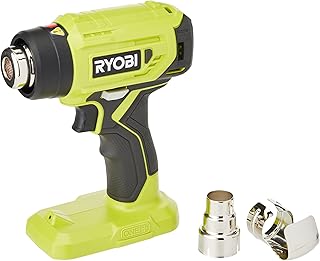
The P3150 is the primary conventional cordless heat-gun option in the current Canadian Ryobi range. Ryobi specifies a maximum temperature of 875°F, 6 CFM airflow, 18V operation, and a three-year limited warranty. It reaches operational temperature in less than 10 seconds according to the manufacturer's specifications.
The tool includes a concentrator nozzle and a deflector nozzle. The concentrator focuses heat on a smaller area, while the deflector spreads and redirects heat for applications such as shrink tubing and pipe thawing. An integrated LED work light can also improve visibility when working in darker areas.
For buyers who already own compatible Ryobi 18V ONE+ batteries, this model has an important convenience advantage: the tool fits into an established battery ecosystem. The Canadian retail listing identifies it as a tool-only product, meaning the battery and charger are purchased separately.
The PCL916B should be considered when precision is more important than the broad output of a conventional heat gun. Ryobi specifies two temperature settings of 450°F and 750°F, with a compact design intended for precise applications. Its listed heat-up time to 700°F is 90 seconds.
The Heat Pen includes deflector and spreader nozzles and is positioned for jobs such as adhesive removal, paint stripping, heat-transfer work, and heat-shrink tubing. The two-temperature design can be useful when working with materials that require more controlled heat than a single high-temperature setting provides.
The PCL916K1 is the kit version of the Heat Pen platform. It is worth comparing with the tool-only PCL916B when you do not already own a compatible 18V ONE+ battery and charger. The key buying question is therefore not simply which model is better, but whether the kit contents justify the difference for your existing tool collection. Ryobi Canada currently lists both the tool-only and kit versions.
The P3150 has the characteristics most shoppers expect from a conventional cordless heat gun. Its 875°F maximum temperature provides substantial heat for many spot-heating tasks, while the 6 CFM airflow rating indicates that it is designed to move a useful volume of heated air.
Its quick warm-up is another practical consideration. Ryobi states that the tool reaches operational temperature in less than 10 seconds. For jobs involving repeated short heating cycles, quick startup can be more useful than simply having the highest theoretical temperature.
The two supplied nozzle types also make the P3150 more adaptable than a basic heat source with a fixed outlet. The concentrator is useful when heat needs to be directed toward a smaller area, while the deflector can distribute heat more broadly around the workpiece.
Maximum temperature is one of the easiest specifications to compare, but it should not be treated as the sole measure of performance. Different materials respond differently to heat, and excessive temperature can damage plastics, finishes, adhesives, wiring insulation, coatings, and other components.
A high-temperature cordless heat gun can be useful for demanding applications, but precise control may be more valuable when working close to delicate materials. This is one reason the Ryobi Heat Pen deserves consideration even though its listed high setting is lower than the P3150's maximum.
When comparing models, look at the complete heat-delivery system:
Heat and airflow work together. A heat gun with substantial temperature capability but unsuitable airflow may not behave the way you expect on a particular task. The Ryobi P3150 is specified at 6 CFM, giving shoppers a useful benchmark when comparing it with other cordless heat guns.
For concentrated work, a nozzle can alter how the available heat reaches the material. A concentrator can intensify heating over a smaller region, while a deflector changes the distribution of the airflow. This means nozzle selection should be considered part of the tool's performance rather than a minor accessory detail.
A cordless heat gun is particularly useful when access to an electrical outlet is inconvenient or when a cord would interfere with movement. Typical applications can include heat-shrink tubing, adhesive softening, paint-related work, certain plastic-forming tasks, and other controlled spot-heating jobs.
The P3150's manufacturer-supplied deflector nozzle is specifically identified for applications including shrink tubing and pipe thawing. However, any heating task involving pipes, plastics, electrical components, coatings, or adhesives should be approached according to the material manufacturer's requirements and the heat gun's operating instructions.
Heat-shrink tubing is one of the clearest use cases for a compact heat source. The objective is to apply enough heat to shrink the tubing evenly without unnecessarily overheating the underlying component or surrounding materials.
A deflector nozzle can be helpful because it distributes heat rather than concentrating the entire output into one small point. Move the heat source consistently and avoid holding intense heat over one location for too long.
Controlled heat can soften some adhesives and make removal easier. The correct temperature depends on the adhesive, substrate, and surrounding components. A lower-temperature setting or more precise heat tool may be preferable when the surface beneath the adhesive is sensitive to heat.
Heat guns can be used in certain paint-removal and surface-preparation applications, but temperature control is essential. Heating should never be assumed to be safe for every coating or substrate. Always check the material and coating manufacturer's guidance before applying concentrated heat.
Some thermoplastics can be softened with heat, allowing controlled forming. However, plastics differ substantially in their heat-response characteristics. A heat gun should therefore be selected and operated according to the specific material rather than simply using its highest available temperature.
The biggest advantage of a cordless heat gun is freedom from an extension cord. This can be valuable when working outdoors, moving around a vehicle, working on a jobsite, or accessing areas where power is not conveniently available.
The trade-off is battery dependency. A corded heat gun can operate continuously as long as suitable mains power is available, whereas a cordless model depends on battery charge and battery capacity. If the tool will be used for long heating sessions, this distinction deserves serious consideration.
A cordless model is often most attractive for intermittent work where portability and fast setup matter more than unlimited runtime. For continuous production heating, a corded tool may remain the more appropriate category.
Battery compatibility can be one of the strongest reasons to choose a Ryobi cordless heat gun. The P3150 belongs to the 18V ONE+ platform, and Ryobi describes the ONE+ system as covering more than 300 products.
If you already own compatible ONE+ batteries, a tool-only purchase can make more sense than buying another battery and charger. If you are new to the platform, compare the total cost of the complete setup rather than judging the price of the bare tool alone.
Always verify compatibility using the current manufacturer's documentation before using a battery with a specific tool. Battery chemistry, physical fit, charger compatibility, and manufacturer's recommendations should all be considered.
The tool-only option is generally worth considering for shoppers who already have compatible batteries and a charger. It avoids duplicating equipment that is already part of a tool collection.
A kit can be more convenient for a first-time buyer entering the battery platform. The Ryobi Heat Pen range, for example, is available in both tool-only and battery-and-charger kit configurations in Canada.
Before purchasing, check exactly what is included. A product labelled tool-only may require a separate battery and charger, which can substantially change the effective purchase cost.
The P3150 is the more conventional choice when you want a full-size cordless heat gun with a high maximum temperature, 6 CFM airflow, quick warm-up, and two application-oriented nozzles.
The PCL916B is more appropriate when compact handling and selectable 450°F or 750°F settings are more important than the P3150's higher maximum temperature. Its design is aimed at precise, heat-sensitive applications.
If you do not already own a compatible Ryobi 18V ONE+ battery and charger, compare the complete kit against the combined cost of buying the tool-only version plus the necessary battery equipment.
A higher temperature rating does not automatically mean better performance for every job. Excessive heat can be counterproductive when working with sensitive materials.
A tool-only listing may look attractive until the required battery and charger are added. Check the complete package before comparing prices between retailers.
The two tool types have overlapping applications but different designs and controls. The P3150 is intended as a conventional heat gun, while the PCL916B emphasizes compact, precise heating with two temperature settings.
Nozzle configuration affects how heat reaches the workpiece. If you frequently work with heat-shrink tubing or need localized heating, examine the included nozzle options instead of comparing the bare temperature specification.
Cordless convenience is valuable, but it does not eliminate the practical limitations of battery-powered equipment. For long-duration stationary heating, a corded model may be a better fit.
Canadian shoppers can also compare Ryobi against other established power-tool brands. Current Canadian retail listings include cordless heat guns from DEWALT and Milwaukee, as well as corded heat guns from brands such as Wagner and BLACK+DECKER.
The best comparison is based on the battery platform you already use, tool specifications, included accessories, ergonomics, warranty terms, and total ownership cost.
DEWALT's cordless heat-gun range includes the 20V MAX DCE530B in Canada. If you already use DEWALT 20V MAX batteries, its platform compatibility may be a decisive factor. If your workshop is built around Ryobi ONE+, the P3150 may offer greater battery-system convenience.
Milwaukee's M18 cordless compact heat gun is another established alternative in Canadian retail channels. Buyers should compare the complete specifications and ownership costs rather than assuming that one brand is universally better.
Wagner offers several corded heat guns in Canadian retail channels. These can be relevant when portability is less important and continuous access to mains power is available. The comparison therefore becomes cordless convenience versus continuous corded operation, rather than simply brand against brand.
A heat gun can reach temperatures high enough to cause burns, ignite combustible materials, damage surfaces, and create hazardous fumes from certain substances. Treat the tool as a high-temperature appliance rather than an ordinary handheld power tool.
Extra caution is necessary around plastic housings, electrical insulation, connectors, circuit boards, and other heat-sensitive components. Heat can travel beyond the visible target area, and a surface can become damaged before the operator notices the change.
For these applications, start with the lowest practical heat setting and maintain appropriate distance and movement. When the material is unknown, identify its heat limitations before applying concentrated heat.
Prices, inventory, retailer promotions, and product availability can change. Canadian shoppers should therefore verify current specifications and today's pricing immediately before purchasing rather than relying on an old buying guide.
Home Depot Canada currently lists the Ryobi P3150, PCL916B Heat Pen, and PCL916K1 Heat Pen Kit in its Canadian heat-gun category. The retailer also lists competing cordless models from DEWALT and Milwaukee, making direct specification and price comparisons possible.
When comparing listings, check whether the advertised price is for a tool-only product or a complete kit. Also verify whether the retailer identifies the exact model number, included nozzles, battery contents, and applicable warranty information.
Customer ratings can provide useful information, but the star average should not be the only factor in a buying decision. Look for repeated comments about battery runtime, heating speed, ergonomics, nozzle retention, durability, and the specific applications people use the tool for.
Separate comments about the product itself from complaints caused by missing batteries, shipping problems, retailer issues, or purchasing the wrong configuration. Review volume can also provide more context than an isolated rating, but neither ratings nor review counts should replace checking the manufacturer's specifications.
Proper maintenance helps preserve reliable operation. Keep the air intake and ventilation areas clear of dust and debris. Inspect the nozzle and housing regularly for damage, and allow the tool to cool completely before placing it in storage.
Battery care is equally important for cordless equipment. Use the recommended charger, follow the battery manufacturer's storage guidance, and avoid storing batteries in unsuitable temperature or moisture conditions.
Do not attempt unauthorized modifications to heating elements, electrical components, battery connections, or safety mechanisms. If a tool develops an electrical, mechanical, or overheating problem, follow the manufacturer's service instructions.
For a conventional cordless heat gun, the Ryobi 18V ONE+ P3150 is the primary model to compare. It has a listed maximum temperature of 875°F, 6 CFM airflow, quick warm-up, and two included nozzles. The best choice still depends on your application and whether you already own compatible ONE+ batteries.
The P3150 is listed as a tool-only product, so the battery and charger are sold separately. Check the exact retailer package before purchasing because kit configurations can differ.
Ryobi lists a maximum temperature of 875°F for the P3150. The manufacturer's Canadian specifications also list 6 CFM airflow.
Ryobi states that the P3150 reaches operational temperature in less than 10 seconds. Actual working conditions can affect how quickly a user perceives the tool as ready for a particular application.
The P3150 includes a concentrator nozzle and a deflector nozzle. The concentrator focuses heat on a specific area, while the deflector changes heat distribution for applications such as shrink tubing and pipe thawing.
No. The PCL916B Heat Pen is a different design intended for precise applications. It provides 450°F and 750°F temperature settings and has a compact form. The P3150 is the conventional heat-gun model with a listed maximum temperature of 875°F.
Neither type is universally better. Cordless models provide mobility and eliminate the need for an extension cord, while corded models can be advantageous for prolonged stationary work where continuous mains power is available.
Yes. Ryobi specifically identifies the P3150's deflector nozzle as useful for shrink-tubing applications. Use controlled movement and appropriate heat to avoid damaging the tubing, insulation, or components underneath it.
It can be a logical option because the P3150 uses the Ryobi 18V ONE+ battery platform. The decision should still be based on your applications, desired heating characteristics, included accessories, and current pricing.
The most important step is to match the heat tool to the work rather than selecting a model solely because it has the highest temperature rating. For general-purpose cordless heat-gun applications, the Ryobi 18V ONE+ P3150 deserves close attention because it combines an 875°F maximum temperature, 6 CFM airflow, fast warm-up, LED lighting, and two useful nozzle configurations.
For more controlled and compact heating, the Ryobi PCL916B Heat Pen offers a different approach with 450°F and 750°F settings. The kit version may be more suitable when a compatible battery and charger are not already available.
Before making a final purchase, compare the exact model number, battery requirements, nozzle configuration, temperature controls, airflow, warranty information, retailer pricing, and current availability in Canada. Most importantly, choose the tool that matches the materials and applications you expect to heat. That approach is more reliable than choosing based on a single specification or a headline rating.