

♥ Wishlist
We analyzed 33 of the most popular Ryobi Cordless Impact Drivers available in ca. Compare features, customer reviews, ratings, and expert recommendations to help you choose the best option in 2026.


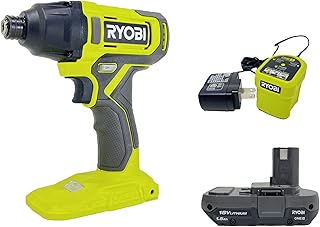


Choosing the best Ryobi cordless impact driver in Canada is not simply a matter of selecting the model with the highest torque figure. The right tool depends on the type of fasteners you use, the available working space, how often you use the tool, the battery platform you already own, and how much control you need over driving speed.
Ryobi's 18V ONE+ platform is particularly relevant for Canadian buyers because the same battery ecosystem covers a broad range of cordless tools. That can make a tool-only impact driver attractive if you already own compatible batteries. However, buyers starting from scratch should compare the complete cost of the tool, batteries and charger rather than looking only at the advertised tool price.
Current Canadian listings show several important differences within the Ryobi range. For example, the PBLID01B 18V ONE+ HP Brushless 1/4-inch impact driver is rated at up to 2,200 in-lbs. of torque, 2,900 RPM and 4,000 IPM, while the newer PBLID04B 4-mode model is listed with up to 2,300 in-lbs. of torque, 3,400 RPM and 4,200 IPM. Compact HP models focus more strongly on reduced size and weight, with the PSBID02B listed at up to 1,900 in-lbs. and 3,900 IPM.
One of the biggest reasons to consider a Ryobi impact driver is the 18V ONE+ battery system. If you already have compatible ONE+ batteries, a tool-only package can be more practical than purchasing another battery and charger.
New buyers should look carefully at the package contents. A tool-only listing normally does not provide a battery or charger, while a kit may include one or more batteries, a charger and a storage bag. The difference can substantially change the overall value of two apparently similar offers.
Battery capacity also affects the experience. A higher-capacity battery can be useful for longer periods of work, while a smaller pack can reduce the weight of a compact impact driver. There is no universally best battery size. The appropriate choice depends on the balance between runtime, portability and the type of work being performed.
Brushless technology is an important feature across Ryobi's ONE+ HP range. Instead of relying on traditional brushes and a commutator arrangement, brushless motors use electronic control to manage motor operation.
For buyers, the practical question is not simply whether a motor is brushless. Consider how the motor, electronics and battery work together. Ryobi's HP range is designed around this combination, with models targeting higher performance, efficiency and durability than basic cordless designs.
A brushless impact driver can be particularly attractive for frequent users who expect to perform repetitive fastening tasks. For occasional household work, however, a lower-priced brushed model may still provide enough capability.
Torque is one of the most visible specifications in an impact driver comparison, but it should not be treated as the only measure of performance.
Ryobi publishes maximum torque figures for its impact drivers in inch-pounds. Current Canadian listings include models rated around 1,700, 1,900, 2,200 and 2,300 in-lbs., depending on the model.
Higher maximum torque can be useful for demanding fastening applications, but it can also be unnecessary for smaller screws and delicate materials. Excessive force may damage fasteners, strip screw heads or damage the material being fastened.
For general DIY work, deck construction, woodworking and routine installation, controllability can be more important than having the highest possible torque rating. This is one reason multi-mode impact drivers deserve attention when comparing models.
RPM means revolutions per minute. It describes how quickly the driver rotates when operating under the conditions specified by the manufacturer.
A higher RPM can help with fast driving, but speed alone does not determine how effectively an impact driver performs under load. Trigger control, electronic settings, torque delivery and impact mechanism design all influence the practical result.
IPM means impacts per minute. Impact drivers combine rotational movement with rapid impacts to help drive fasteners under load.
A high IPM rating can indicate an aggressive impact mechanism, but buyers should compare it alongside torque and RPM. A model with slightly lower IPM may still be a better choice if it provides superior control, a more compact body or more useful operating modes.
A multi-mode impact driver can be more versatile than a single-speed design because it gives the user greater control over how power is delivered.
The Ryobi PBLID02B, for example, is listed with three speeds plus Assist Mode. The newer PBLID04B also provides three speeds plus Assist Mode and a variable-speed trigger.
These settings can help when switching between different fasteners and materials. Lower settings can be useful when precision matters, while higher settings can help with larger fasteners and more demanding applications.
Assist Mode is particularly relevant when you frequently move between different fastening tasks. It can help reduce the tendency to overdrive certain fasteners by changing how power is delivered.
For someone building furniture, installing hardware, assembling cabinets or performing mixed repair work, a controlled impact driver can be easier to live with than a tool designed only for maximum output.
Compact impact drivers are designed for situations where tool length and weight matter. The Ryobi PSBID01B is listed at 5.3 inches in length, with up to 1,700 in-lbs. of torque and up to 3,800 IPM.
The newer PSBID02B compact model is also listed at approximately 5.3 inches, but raises the published maximum torque to 1,900 in-lbs. and IPM to 3,900, with up to 3,000 RPM.
Compact dimensions can make a noticeable difference when working inside cabinets, between framing members, underneath furniture or above shoulder height. They can also reduce fatigue during repeated overhead tasks.
Full-size models can make more sense when maximum output and advanced control features are more important than the smallest possible body.
The newer PBLID04B is listed as Ryobi's most powerful impact driver, with up to 2,300 in-lbs. of torque, up to 3,400 RPM and up to 4,200 IPM.
That additional capability can be useful for demanding fastening work. However, maximum performance does not automatically make a tool better for every user. A compact driver may be more comfortable for routine household work where extreme output is rarely required.
Most Ryobi cordless impact drivers in this category use a 1/4-inch hex interface. This makes them suitable for compatible impact-rated driver bits, sockets with the appropriate adapter and other accessories designed for impact-driver use.
The quick-connect design is useful when switching between bits. Some Ryobi models feature a one-handed bit release, which can make repetitive work more efficient. The PBLID01B, PBLID02B and PBLID04B listings all highlight quick bit-changing functionality.
Always select accessories that are appropriate for impact-driver use. Standard drill bits and ordinary driver accessories are not automatically suitable for the repeated shock loading produced by an impact mechanism.
An impact driver and drill driver are complementary tools rather than direct substitutes.
An impact driver is not normally the first tool to choose for drilling ordinary holes unless you have the correct impact-rated accessories. A drill driver provides a more versatile drilling interface for many applications.
For buyers who want both capabilities, Ryobi sells combination kits that pair an impact driver with a drill or hammer drill. Current Canadian listings include compact HP combination kits using the ONE+ platform.
For occasional home maintenance, you may not need the highest-output Ryobi model. A basic ONE+ impact driver can be sufficient for assembling furniture, installing screws, completing small repairs and handling general fastening tasks.
The most sensible choice depends on what you already own. If you have ONE+ batteries, a tool-only model can simplify the purchase. If you do not own any compatible batteries, compare the complete kit price and included battery capacity.
Homeowners should also prioritize control. A model with multiple speed settings can be easier to use on smaller fasteners than a high-output driver operated only through the trigger.
Deck construction and similar projects often involve repeated fastening, larger screws and long working sessions. In these situations, higher torque, efficient battery use and ergonomic handling become more important.
A brushless HP model can be worth considering when the tool will be used frequently. Multi-mode control is also useful because construction work can involve both demanding structural fasteners and smaller hardware.
Before buying, consider the battery strategy. If the project requires many hundreds of fasteners, having more than one compatible battery may be more useful than choosing a slightly more powerful tool.
Compactness is one of the strongest reasons to choose the PSBID-series models. The current PSBID02B is listed as a 5.3-inch compact brushless impact driver with up to 1,900 in-lbs. of torque and 3,900 IPM.
A shorter tool body can provide additional clearance between the rear of the tool and nearby surfaces. This can make a difference when working inside cabinets, under shelves or in narrow framing spaces.
Compact tools can also be easier to maneuver during overhead work. However, users should still compare total weight with the chosen battery because the tool-only specification does not represent the complete working weight.
Battery capacity is commonly expressed in amp-hours, or Ah. Larger Ah ratings generally provide more stored energy, although actual runtime depends on the tool, load, fastener size, material and working conditions.
A small battery can make a compact impact driver feel lighter. A larger battery can reduce the frequency of battery changes during heavy work. The right choice is therefore a compromise between runtime and ergonomics.
For occasional DIY jobs, one compatible battery may be adequate. For construction or renovation work, having multiple charged batteries can be more convenient.
Canadian listings demonstrate how much package configuration can vary. For example, the PBLID02B is offered as a tool-only product, while the PBLID02KERR package includes two 2.0 Ah batteries, a charger and a bag.
Maximum torque is useful, but it does not tell you everything about handling, speed control, size, battery efficiency or suitability for small fasteners.
A tool-only listing may look inexpensive until you realize that a battery and charger are also required. Always compare complete system costs.
A powerful full-size driver may be inconvenient in confined spaces. Measure the working area and consider whether a compact model would provide better access.
Impact mechanisms subject accessories to repeated shock loads. Use bits, sockets and adapters specifically designed and rated for impact applications.
More power can be useful, but excessive force is not always desirable. For delicate fastening, controllability can be more important than maximum output.
Ryobi has several generations and configurations of impact drivers. Similar product names can refer to different specifications. Always check the exact model number, included accessories, battery configuration and technical specifications before purchasing.
When comparing candidates, evaluate them in the following order:
The ONE+ and ONE+ HP families serve different priorities. Standard ONE+ tools can be attractive for occasional users and buyers who want access to a broad cordless ecosystem without necessarily needing maximum performance.
ONE+ HP models are positioned toward increased performance and use brushless motor technology with advanced electronics and compatible high-performance batteries.
That does not mean every user should automatically choose HP. If your typical jobs involve small screws and occasional repairs, the extra capability may not provide a meaningful advantage. If you regularly drive larger fasteners or use the tool for extended periods, HP models become more compelling.
Impact drivers can generate considerable force, so grip shape, balance, trigger control and tool weight all influence comfort.
A compact driver may feel easier to control during overhead work. A heavier battery can improve runtime but may increase wrist fatigue. A high-output model can be excellent for demanding jobs but unnecessarily bulky for light maintenance.
If possible, compare the tool with the battery installed rather than judging only the bare-tool weight. The battery is part of the equipment you will actually hold.
Integrated LED lighting is a useful convenience feature on many Ryobi impact drivers. It can help illuminate fasteners in cabinets, framing areas and other locations where ambient light is limited.
Do not treat an onboard LED as a replacement for appropriate workplace lighting. It is primarily a visibility aid close to the fastening point.
Frequent impact work places stress on the drive mechanism and housing. Several Ryobi HP impact drivers use a die-cast gear case, a feature highlighted in current Canadian product descriptions.
For professional or heavy DIY use, look beyond one durability feature. Consider the overall construction, expected workload, service documentation, warranty terms and availability of compatible accessories.
Canadian shoppers should compare the exact configuration available in Canada rather than relying on specifications from another market. Product names, model numbers, kit contents and pricing can differ between countries.
Currency is another consideration. Compare the final Canadian-dollar price, including any applicable delivery charges or taxes, rather than converting a foreign listing and assuming the result will be identical.
Availability can also change. A model that is listed online may have different store availability depending on region. Check the current Canadian retailer listing before making a purchasing decision.
For example, Canadian Home Depot listings currently show multiple Ryobi impact-driver configurations, including tool-only products and kits with batteries and chargers.
Prioritize affordability, simplicity, battery compatibility and adequate torque. There is little reason to pay for maximum output if the tool will only be used a few times each year.
Look for a brushless model with good ergonomics, useful speed control and a battery setup that supports extended work.
Higher torque and impact performance become more valuable. A multi-mode HP model may provide a useful combination of power and control.
Compact dimensions and precise control can matter more than maximum torque. A compact HP model may be easier to maneuver around confined workpieces.
Focus on the entire operating system. Battery availability, runtime, durability, ergonomics, speed control, accessory compatibility and warranty terms can matter as much as headline power.
Impact drivers are powerful fastening tools and should be used with appropriate personal protective equipment and safe working practices.
Customer ratings can provide useful buying information, but they should not be treated as a substitute for technical specifications.
When reading verified customer reviews, look for recurring comments about battery life, ergonomics, chuck or collet behaviour, trigger control, durability, noise and real-world application suitability. A single unusually positive or negative review provides less information than a consistent pattern across many relevant reviews.
Also distinguish reviews of the exact model from reviews of a related Ryobi product. Similar names can make this surprisingly easy to overlook.
Value is not simply the lowest purchase price. A good-value impact driver should provide the performance you actually need without forcing you to pay for features that will remain unused.
For an existing ONE+ owner, a tool-only model can offer strong system value because batteries and chargers may already be available. For a new user, a kit can be more economical when the included battery and charger would otherwise have to be purchased separately.
Long-term value also depends on whether the battery platform can support additional tools you are likely to purchase later. The broader ONE+ ecosystem can therefore be part of the buying decision.
If you already own Ryobi ONE+ batteries and mainly perform household repairs, start by comparing compatible tool-only models. If your work involves tight spaces, put compact dimensions near the top of your criteria.
If you regularly drive large fasteners, compare the higher-output HP models. If you switch between large and small fasteners throughout the day, prioritize a model with multiple modes and useful electronic control.
If you are building a Ryobi collection from scratch, compare kits rather than bare tools. A kit may provide more practical value when it includes batteries and a charger you would otherwise need to purchase separately.
There is no single best model for every Canadian buyer. The right choice depends on your workload, required torque, preferred size, battery ownership and budget. Current Canadian listings include compact models for confined spaces and higher-output HP models for demanding fastening.
Ryobi's ONE+ platform can be a practical option for DIY users who want one battery system across multiple cordless tools. The best model depends on the type and frequency of work you perform.
Yes. The Ryobi ONE+ HP impact-driver models discussed in current Canadian listings use brushless motor technology.
The current Canadian listing for the PBLID04B describes it as the most powerful Ryobi impact driver and lists up to 2,300 in-lbs. of torque, 3,400 RPM and 4,200 IPM. Specifications and product availability can change, so verify the current model information before buying.
For many DIY and general fastening tasks, yes. Current compact HP models are listed with up to 1,900 in-lbs. of torque, which is substantial for a compact tool. The appropriate choice depends on your fastener size and workload.
A tool-only version makes the most sense when you already own compatible 18V ONE+ batteries and a charger. If you do not, compare the total cost of a kit against buying each component separately.
No. Although an impact driver can handle some drilling tasks with suitable accessories, a conventional drill driver remains better suited to many drilling applications. A two-tool combination can provide greater versatility.
Choose battery capacity according to your workload. Smaller batteries can keep the tool lighter, while larger-capacity packs can provide more runtime. There is no universal best size for every application.
Use accessories specifically designed for impact-driver applications where required. Impact-rated accessories are engineered for the repeated shock loads generated by impact mechanisms.
They can be well suited to repetitive screw-driving work such as decking, provided the selected model has suitable output and the correct fasteners and accessories are used. For long projects, battery capacity and ergonomics are also important.
Check the exact model number, Canadian specifications, battery and charger contents, retailer availability, current price, warranty information and return conditions. Product configurations can change, so avoid relying solely on older reviews or listings.
The best Ryobi cordless impact driver in Canada is the one that matches your actual work rather than the one with the most impressive specification sheet. For demanding applications, the latest HP 4-mode models offer substantial output and multiple control settings. For tight spaces and overhead work, compact HP models can provide a better balance between capability and maneuverability.
Before purchasing, compare the exact model numbers and package configurations. A tool-only product and a battery kit can look similar while delivering very different overall value. Also consider whether your existing batteries make the ONE+ platform more attractive.
Most importantly, match the driver to your fasteners, materials and working environment. Torque, RPM and IPM matter, but so do size, weight, control, battery strategy and accessory compatibility. A carefully matched impact driver should make repetitive fastening easier without giving you more power than the job requires.
Use current Canadian retailer listings and manufacturer documentation to verify specifications, included accessories, warranty terms, availability and today's price before completing your purchase. Product details can change during the year, so the exact model and configuration should always be confirmed at the time of buying.